The Archive Does Not Collect the Past
Archives normally preserve what has happened. They collect documents, images, objects and records in order to organise the past and make it available to the future. Whatever is admitted into an archive acquires a particular status. It becomes evidence that an event, a person or an action actually existed.
Archive of Possible Lives reverses this principle.
This archive collects no evidence. It contains no historical documents and no verified memories. Instead, it produces fragments of events that may never have taken place. It archives not what has been, but what might have been: unrealised decisions, alternative relationships, diverted paths through life and futures that could have emerged from a different turning point.
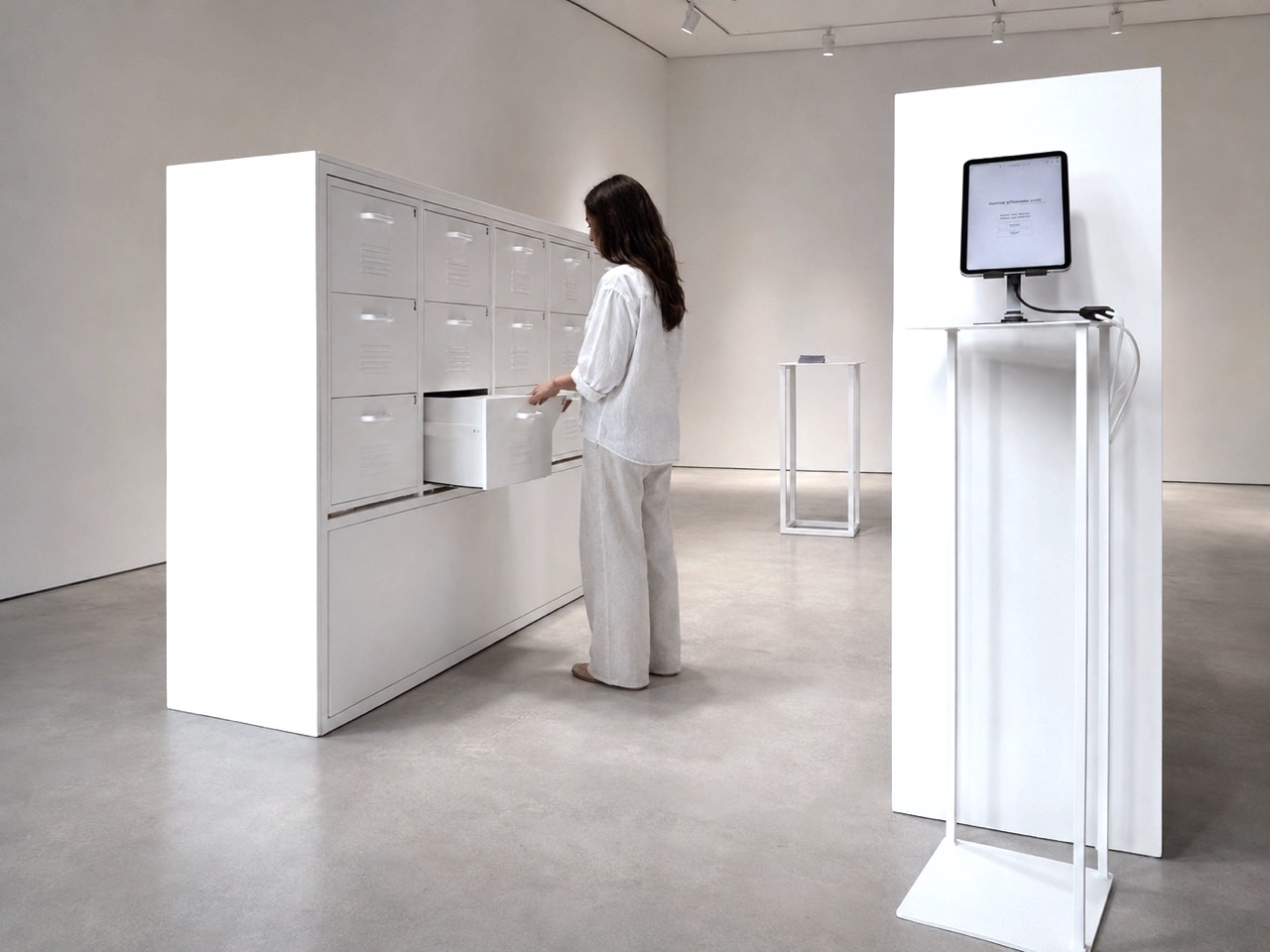
The form of the archive remains intact. There are numbered drawers, a defined order, printed documents and an envelope in which the texts are collected. Everything recalls an institution that administers knowledge and documents reality. Yet this familiar form now contains something fundamentally uncertain.
The texts do not emerge from the visitor’s past. They emerge from statistical probabilities. A language model calculates which words, sentences and biographical connections might plausibly follow one another within a particular context. It does not know whether an event it describes is true. It has no access to the memories of the person standing in front of the drawer.
And yet a text can appear credible. It may recall an actual experience, touch upon a repressed possibility or trigger an idea that did not previously exist. For a moment, probability takes on the form of memory.
This is the central shift enacted by the work: the archive preserves no truth. It produces plausibility.
The individual fragments are therefore not alternative facts. They are linguistically generated hypotheses. They do not reveal who the visitor truly is or might have been. They show how easily a narrative that feels personal, coherent and credible can be formed from general cultural patterns.
The archive thus makes visible a development that extends far beyond the installation. Generative systems now produce texts, images, voices and descriptions of the self that no longer arise directly from a past event. Nevertheless, they can convey the impression of a document, a testimony or an authentic statement.
The more convincing these outputs become, the more difficult it becomes to distinguish between what was documented and what merely appears possible.
Archive of Possible Lives translates this uncertainty into a physical experience. A text emerges from a real drawer. It is printed on paper, taken into the hand and later preserved in an envelope. A statistical calculation becomes an object. A possibility assumes the form of a document.
Back to contents ↑Identity as a Space of Probability
Human beings do not understand their lives as a mere sequence of isolated events. They connect experiences into a narrative. Childhood, decisions, relationships, successes, losses and expectations are retrospectively linked in such a way that they appear to form a coherent biography.
Yet this narrative is never complete.
Memories change. The past is repeatedly reassessed from the perspective of the present. Some events acquire significance only years later, while others lose their weight. Nor does our idea of who we are remain unchanged. Identity is not a fixed substance that can be discovered once and for all. It is continuously produced through memory, self-description, social attribution and expectation.
Artificial intelligence is now increasingly entering this process.
Language models can compose biographies, write personal letters, simulate conversations and describe possible futures. They can generate the linguistic tone of intimacy and construct an apparently coherent personality from very little information. In doing so, they do not draw upon an inner understanding of the human being. They rearrange statistically learned patterns.
For a language model, biography is first of all language.
It contains countless narratives about how people describe their childhood, how they speak about relationships, how turning points are represented and what hopes are associated with the future. From these patterns, the system can produce new combinations. It calculates which formulation might appear probable, appropriate or convincing in a particular situation.
This creates a new space of possible identities.
AI does not merely describe what a person has already said about themselves. It can propose alternative connections. It can give an unlived life such linguistic specificity that it becomes imaginable. What previously had no form acquires a narrative.
This narrative remains a construction. But constructions are not without effect.
People orient themselves towards the stories that are told about them. They accept attributions, reject them or alter them. Even an invented description can provoke a real response. It can produce agreement, resistance, grief, relief or curiosity. A text does not have to be true in order to move something within a person.
The installation therefore examines identity as a space of probability that is both expanded and structured by artificial intelligence. The system appears to open up many possibilities. Yet these possibilities do not arise in an empty space. They are drawn from existing linguistic, social and cultural patterns.
What AI generates as a possible life depends upon which lives have previously been described, which narrative forms are present in its training data and which ideas of a plausible biography are culturally dominant. Even apparently open possibility therefore has limits.
The decisive question is not only which new identities AI can produce. It is equally important to ask which identities it repeats most often, which forms of life it treats as plausible and which possibilities remain barely visible within its statistical structures.
The machine opens a space of possible lives. At the same time, it organises that space according to probability.
A new form of influence emerges from this. AI does not directly tell a person who they are. It offers narratives in which they might recognise themselves. The more routinely such systems participate in our descriptions of ourselves, the more their statistical patterns can contribute to shaping how we imagine ourselves.
Back to contents ↑The Machine Does Not Know the Visitor
The texts produced by the archive can feel personal. They address the visitor directly. They use the name the visitor has entered and refer to fundamental experiences of human life. At times, a sentence seems to fit with surprising precision. A formulation can create the impression that the system has recognised something that had not previously been expressed.
But the machine does not know the visitor.
It has no access to the visitor’s childhood, relationships or decisions. It cannot know what that person has experienced, repressed, lost or hoped for. It does not recognise a hidden personality. It performs no psychological analysis and produces no diagnosis.
The system calculates language.
A new text emerges from the artistic instructions, the respective thematic field, the course of the current tour and the statistical structures of the language model. This text may sound precise without being based on precise knowledge of the person.
This is precisely where the persuasive power of generative AI lies.
Human beings do not encounter language as neutral material. They look for intention, coherence and meaning within it. When a text is written in the second person, includes one’s own name and appears in a quiet, concentrated situation, its effect changes. It is no longer read as an arbitrary piece of generated language. It is perceived as a personal address.
The machine produces the linguistic form. The visitor establishes the biographical connection.
The visitor links the sentence to personal memories, fills in gaps and decides what might apply to their own life. In this way, a general fragment can acquire a highly specific meaning. Individuality does not reside solely in the generated text. It also emerges through the interpretation of the human being.
This does not mean that the experience is unreal.
The text is based on a statistical calculation. The visitor’s response can nevertheless be real. A memory triggered by an invented sentence is an actual memory. A thought produced by a random formulation is an actual thought. The machine does not understand this process. The human being experiences it nonetheless.
Here the fundamental difference between machine simulation and human experience becomes visible.
A language model can produce the form of understanding. It can write as though it had listened, reflected or recognised something. Yet behind this language there is no counterpart that participates in the experience. There is no experience, no memory and no consciousness from which the sentences emerge.
The installation does not conceal this absence. It makes it part of the work.
The visitor stands before a system that knows nothing about them and yet produces something that appears to refer to them. The actual encounter arises within this tension: not between two forms of consciousness, but between machine-generated probability and human meaning-making.
The archive therefore also asks why people are willing to feel addressed by a system that does not know them. Perhaps the fascination of AI lies not only in its technical capabilities. Perhaps it also lies in our desire to be recognised in language.
The machine does not know the visitor. Yet it creates a space in which the visitor may encounter themselves.
Back to contents ↑Between Chance and Authorship
The texts in the archive are generated with the help of a local language model. The language model is a tool within the artistic arrangement developed by Florian Mehnert.
Each text is generated within a structure that has been artistically defined in advance. Florian Mehnert developed the spatial arrangement, the sequence of the tour, the thematic fields, the linguistic rules, the technical conditions and the boundaries within which the model can respond.
The six themes of the archive are:
childhood, self-efficacy, relationships, decisions, another possible life and the future.
This selection is not an objective or universally valid theory of human life. It does not claim that every biography can be fully captured within six categories. The themes are a personal choice made by the artist. They indicate which areas Florian Mehnert considers fundamental to the narration of a life.
The structure of the archive is therefore already an artistic statement by Florian Mehnert.
Before the AI generates a single sentence, a decision has already been made about which questions can enter the space at all. Other themes remain excluded. Other forms of organisation would have been possible. The six stations therefore do not constitute a neutral selection, but an artistic perspective on life.
Chance operates within this order.
The visitor is directed towards a particular drawer without knowing which specific text fragment will be generated there. The model does not consciously choose between different paths through life. It calculates a linguistic continuation within the given conditions. Small variations in this calculation can lead to a different sentence, a different atmosphere or a different direction in the emerging biography.
Chance here does not mean complete arbitrariness. It operates within a designed system.
The language model itself is not neutral either. Its possibilities are based on texts that were written, collected, selected and technically processed by human beings. Its statistical structures contain cultural ideas, social norms, linguistic conventions and historical inequalities.
Different technical and linguistic processes contribute to the creation of the individual text fragments. The artistic authorship lies with Florian Mehnert, who developed the system, its conditions and rules, its themes, its spatial form and its dramaturgical sequence.
The language model generates variations within these conditions. The training data provides the cultural patterns from which the model draws. The visitor chooses, opens, reads, interprets and connects the fragments into a possible life.
The specific text emerges from the interplay of these different levels within the arrangement created by the artist.
The artist’s responsibility does not disappear behind the technology. Anyone who uses a generative system does not merely design an open process. They decide which model is used, which rules apply, which language is possible and within which context the results appear.
In the archive, the language model is therefore neither an autonomous artistic subject nor a merely neutral tool. It is an operational component of the artistic arrangement.
Its unpredictability is utilised, but not confused with freedom. Its language is made visible, but not presented as the expression of a consciousness of its own. The work only comes into being through the interplay of the system as a whole: the AI that generates the texts, the artistic arrangement and the human being who gives meaning.
Back to contents ↑Artificial Intelligence Becomes Material
Artificial intelligence usually encounters us through smooth surfaces. We type into a text field, touch a screen and receive a response within seconds. The technical infrastructure remains invisible. Data centres, streams of data, models and calculations of probability disappear behind an apparently immediate dialogue.
Archive of Possible Lives removes AI from this familiar interface.
Visitors do not stand in front of a chat window. They move through a space. They search for a numbered drawer, open it by hand, wait for the sound of the printer and remove a strip of paper.
The calculation becomes a spatial process.
Behind the drawers are sensors, network connections, a locally operated language model and thermal printers. Opening a drawer triggers a technical process. Language is produced in the background and, a few moments later, emerges as a material printout.
The text is no longer only information. It becomes an object.
It has a format, a weight and a surface. It can be folded, collected, damaged or lost. At the end, it is placed in an envelope together with the other fragments. A fleeting calculation becomes a personal collection of documents.
Materiality changes the perception of language.
A sentence on a screen can be closed, overwritten or wiped away. A printout is taken into the hand. It occupies space and can leave the site of the installation. It therefore acquires a different form of binding presence, even though its content remains based on probability.
This contradiction is essential: the more uncertain the origin of the text, the more concrete its material form appears.
The thermal paper also contributes to this meaning. At first, it appears to be a documentary medium: a receipt, a ticket or the record of a completed process. At the same time, it is not permanent. Light, heat and time alter the printout. The writing can slowly fade.
The apparent document already carries its own transience within it.
The installation thus connects two opposing movements. The archive preserves, yet the material disappears. The machine produces an apparently personal memory, yet the text has no remembering subject. The drawer suggests order, while its contents emerge from statistical openness.
In the installation, AI acquires a body without itself becoming embodied.
Its body consists of cabinets, cables, sensors, printers, paper and the visitor’s path through the space. The technical system is not merely illustrated. It is translated into a physical action.
The visitor does not only read the AI. The visitor touches its infrastructure.
Back to contents ↑Intimacy and Projection
Intimacy does not arise solely from personal information.
It can also be produced by a situation: by direct address, silence, concentration and the feeling that a text has been created only for this one moment and this one person.
The archive produces such a situation.
The visitor moves alone through the six stations. Each drawer contains a new text. The visitor’s own name appears on the printout. The fragments speak of experiences, decisions and possibilities that belong fundamentally to human life.
This form produces closeness.
Yet this closeness does not result from the system actually knowing the person. It arises through language and through the visitor’s willingness to relate that language to themselves.
Human beings are predisposed to recognise connections. They complete unfinished narratives, interpret suggestions and connect new information with their own experiences. Open-ended texts in particular can feel personal because they leave space for readers to locate themselves within them.
The language model provides an offer. The visitor completes it.
This projection is not an error occurring outside the work. It is a central component of the installation. The archive examines how quickly machine-generated language can become a mirror.
A mirror possesses no knowledge of what appears within it. Nevertheless, the reflected image can be meaningful to the person looking at it.
AI functions in a similar way. It produces no inner insight into the visitor. It provides linguistic structures in which thoughts, memories and fears can be reflected. The more convincing the language becomes, the more easily the origin of the text can recede into the background.
The visitor may cease to ask how the sentence was calculated and begin instead to ask whether it applies to their life.
A social dimension lies within this transition. Generative systems are increasingly used as conversational partners, advisers and personal companions. People share intimate thoughts with them and receive answers that simulate understanding. The system remains without experience. The relationship can nevertheless feel subjectively real.
Archive of Possible Lives condenses this process into an artistic situation.
It neither simply presents the human being as deceived nor claims that the machine can reveal a hidden truth. It keeps both levels open at the same time: AI does not understand. Yet the human experience of its language can still possess meaning.
At the end, the archive explicitly returns that meaning to the visitor.
The six texts now belong to the visitor. They decide what continues to resonate and what remains without significance. The system claims no final interpretation. It does not explain which statement is correct or which insight should be drawn from the tour.
The card inside the envelope bears the sentence:
The truth is within you.
This sentence does not confirm every inner feeling as truth. Rather, it ends the machine’s claim to continue writing the visitor’s biography. The assessment of what has been experienced is returned to the human being.
What was merely plausible? What recalled an actual experience? Where did meaning arise only through one’s own projection? And why could a system that knew nothing about this person appear so personal for a moment?
Back to contents ↑Data Protection and Transience
A work about artificial intelligence and personal biography immediately raises the question of data.
Many digital systems function by collecting information, storing it permanently and connecting it into profiles. Individual actions are recorded, evaluated and linked to earlier data. From these connections, predictions are produced about interests, behaviour and future decisions.
The archive follows a different logic.
Only a small amount of information is temporarily required for the tour: the entered name or alias, the selected language and the current state of the session. These details are used to organise the visitor’s path through the installation and assign the printouts to that session.
They do not form a digital biography.
The language model runs locally on the installation’s computer. The personal tour is not transmitted to an external AI service. Once the tour has ended, the session is reset. The visitor’s name and the context of the tour are not retained as a permanent personal profile.
The system is not intended to know the visitor better and better.
This limitation is not only a technical measure for data protection. It is part of the artistic concept. The archive produces a personal narrative without having to permanently capture the person for whom it is generated. It demonstrates that minimal information and general linguistic patterns are already sufficient to create the impression of an individual address.
The apparent precision of the text therefore does not arise from comprehensive data collection. It arises from the model’s ability to translate probability into a convincing linguistic form.
The personal fragments leave the system on paper.
The visitor decides whether to take them away, preserve them, share them or destroy them. The digital session ends while the analogue document remains with the visitor. The archive forgets what it has just produced.
In this respect, the installation differs fundamentally from most digital archives.
Normally, the digital trace remains while human memory fades. In Archive of Possible Lives, the digital association is deleted while the fragile printout remains. Yet even this printout is not permanent. The thermal paper changes and may disappear over time.
Forgetting is therefore not a malfunction of the archive. It belongs to its structure.
The QR code on the final printout also does not lead to a personal evaluation of the tour. The linked page is identical for every visitor. It contains no stored drawer numbers, no individual texts and no retrospective psychological interpretation.
It opens only the artistic and philosophical background to the work.
The personal experience remains with the visitor. The archive makes no claim upon it.
Back to contents ↑Artistic Context
Archive of Possible Lives forms part of Florian Mehnert’s long-standing artistic engagement with digital technologies, surveillance, data structures and social behaviour.
In earlier works, Mehnert examined how technical systems intervene in the relationship between the individual, the public sphere and power. Projects such as Waldprotokolle, Humantracks, 11 DAYS and Freiheit 2.0 made visible the ways in which technological infrastructures can record and influence human behaviour—or can create entirely new social situations in the first place.
Technology has always served as an artistic tool. The central question was always what these systems do to human beings: to their perception, their behaviour, their understanding of freedom and their relationship to society. Invisible technical and social processes were translated into spatial, visual or social situations.
The project 11 DAYS occupies a particular position within this body of work. Technically demanding, it was at the same time a social experiment. It created a precisely defined situation in which human behaviour could not be fully predicted. The work therefore did not consist solely of its technical construction or its outward form. It emerged substantially from the reactions, decisions and public controversies generated by the experimental arrangement.
This creates a direct connection to Archive of Possible Lives. Here, too, the artist develops a complex technical and dramaturgical system without completely determining the specific outcome. The work only comes into being in the encounter with the visitor. Their decisions, projections and reactions to the generated texts become an essential part of the work.
Both projects combine a controlled artistic structure with an open social process. The technical systems establish conditions. They do not, however, fully determine what happens within those conditions. It is the human being who transforms the arrangement into an experience and the experiment into a work of art.
In Data to Light, data was transformed into light and thereby made physically perceptible in public space. Other works translated surveillance, movement or digital communication into drawing, installation and social sculpture. Technology was not represented; it was transformed into a situation in which its social effects could be experienced directly.
Archive of Possible Lives continues this method while shifting its focus.
The earlier digital systems often recorded what people had actually done. The archive now turns towards what never happened. It examines not only the storage of behaviour, but the algorithmic production of possible identity.
The work responds to a new stage of digitalisation.
Digital systems no longer restrict themselves to documenting reality and predicting behaviour. Generative AI has begun to produce texts, images and narratives of its own. It describes people, formulates their thoughts, constructs their futures and offers them linguistic models of the self.
This development is also central to the book KI und die Zukunft unserer Gesellschaft (AI and the Future of Our Society), published by Florian Mehnert together with Dr Stefan Brink. The book considers artificial intelligence not as a technical tool, but as a cultural and social phenomenon. It examines why people perceive machine-generated language as understanding them and what consequences this perception may have for thought, responsibility and society.
The archive translates this theoretical question into a physical and social experience.
The assertion that AI does not understand remains no longer abstract. The visitor encounters a system that knows nothing about them and nevertheless produces personal texts. They can experience directly how quickly statistically generated language can be perceived as meaningful.
The installation thereby becomes an artistic experiment concerning the power of narrative.
AI possesses no biography. It has no past, no childhood, no relationships and no conception of the future. Nevertheless, it can simulate all of these in language. It can generate possible lives because human lives exist within its data as recurring patterns.
The work asks what role machine-generated narratives will play in our future understanding of ourselves.
Will we use AI merely to express thoughts that already exist? Or will its suggestions increasingly determine which thoughts, decisions and paths through life we consider possible? What happens when people recognise themselves in machine-generated narratives and those narratives become part of their own biography?
Archive of Possible Lives offers no final answer to these questions.
As in 11 DAYS, Florian Mehnert creates an experimental arrangement in which technical control and human unpredictability encounter one another. The system is precisely constructed. What it triggers within the individual remains open.
The archive does not tell us who we are.
It shows how easily a machine can narrate who we might have been.